

Why Does My New Home Still Have Plumbing Problems?
Most homeowners assume a newer home means newer pipes, with no new home plumbing problems for decades.
However, we get calls regularly from owners of homes built in the 2000s and even the 2010s. They are dealing with leaks they were told would not happen for another fifty years.
The age of a home and the condition of its plumbing are not always the same story. Here is what actually drives plumbing failures in newer construction.
Why New Home Plumbing Problems Happen Even When the Pipes Are New
Most of what we write about older homes assumes the material is sound. The failure is simply a matter of time and water chemistry. Newer homes introduce a different set of variables entirely.
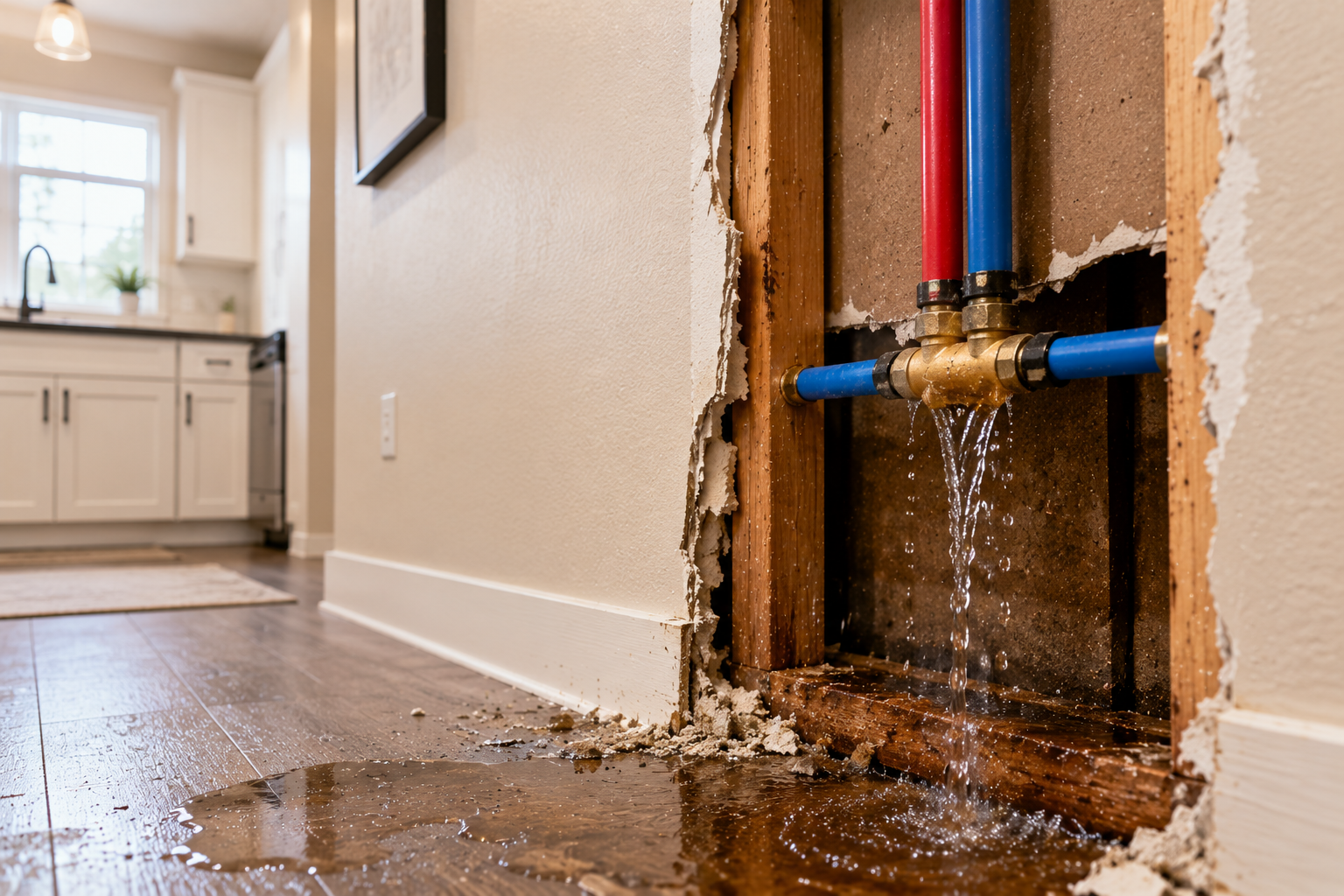
Construction quality varies between builders. It can even vary between phases of the same development. A subcontractor working quickly to meet a deadline can install fittings incorrectly. That mistake is not visible at final inspection. As a result, a brand-new home can leave the lot with a defect already built into the wall.
This is why we sometimes see a five-year-old home with a pipe failure. It looks nothing like the slow pitting corrosion typical of a forty-year-old system. The cause is different. So is the fix.
The Most Common Culprit: Fitting Connections, Not the Pipe Itself
In most new-construction leak calls, the pipe material is not the problem. The connection point is.
Builders use PEX piping widely in new California construction. It installs quickly and bends around framing without extra fittings. However, every connection still relies on a crimp ring, clamp, or expansion fitting to seal properly. A rushed crew can crimp a fitting slightly out of alignment. A poorly calibrated tool can leave a weak seal. Either mistake can hold for months or years before finally giving way.
Brass fittings add another layer of risk. Some fitting designs are more prone to a corrosion process called dezincification. Zinc leaches out of the brass over time and leaves the fitting brittle. This issue has driven real, documented litigation in the plumbing industry. It is separate from the gradual mineral corrosion we discuss with aging copper systems. Either way, the homeowner ends up with the same result: a leak inside a wall nobody expected this early.
Builder-Grade Does Not Always Mean Builder-Quality
Production homebuilders work on tight margins and tighter schedules. That pressure does not always show up in the finished product. It often shows up in what is hidden behind the drywall.
Developments frequently pay plumbing subcontractors per unit completed, not per hour worked carefully. As a result, a crew moving fast through forty identical floor plans may miss an imperfect crimp here and there. They may also over-torque a fitting without noticing. None of that shows up during a standard final walkthrough. The system has not yet faced sustained pressure and temperature cycling at that point.
This is one of the most common sources of new home plumbing problems we see in production developments.
Why a Repair Does Not Always Solve a New-Construction Leak
A leak in a newer home often triggers the same instinct. Patch that one spot and move on. That approach can work for a true one-off installation mistake.
However, a systemic issue tells a different story. A batch of defective fittings used throughout the home is one example. A subcontractor repeating the same installation error on every connection is another. Patching one leak does very little to address what is waiting behind the next wall in either case. We have walked into homes where one visible leak turned out to be the first of several. Additional access points revealed the rest.
For a deeper look at how to tell whether a leak is isolated or systemic, read this → How Many Leaks Does It Take Before You Need a Repipe?
What to Do If Your Newer Home Has Already Leaked
Is your home under fifteen years old? Has it already had one plumbing failure? A few steps are worth taking before assuming it was simply bad luck.
Ask your plumber directly what type of fitting failed and why. Push back on a vague answer like “these things just happen sometimes.” Additionally, check whether your home’s builder or development has a documented history of plumbing defects. This sometimes surfaces in online forums or HOA records for larger communities. A second leak within a year or two of the first points toward a systemic installation issue rather than a fluke.
A full evaluation from a repipe specialist can confirm which situation you are dealing with.
What a Repipe Looks Like for a Newer Home
Repiping a newer home is often more straightforward than repiping an older one. Routing and access points are usually well documented. The framing has not shifted over decades either.
For most standard single-family homes, a whole-home repipe with Creative Repipe runs between $6,000 and $14,000. The final number depends on square footage, number of bathrooms, and material choice. Most homes are completed in one to two days. Every repipe includes a Lifetime Transferable Warranty regardless of the home’s age.
We give you a firm number after a free in-home evaluation. We never give a phone estimate. Additionally, we beat any written quote from a licensed competitor.
For more on what that warranty actually covers, read this → What Is a Whole Home Repipe?
Get a Free Evaluation, Regardless of Your Home’s Age
We do not assume a newer home is automatically fine. We do not assume an older home is automatically failing either. Every evaluation starts with looking at what is actually in your walls.
Call Creative Repipe at (888) 373-0046 Or CLICK HERE to receive your free estimate.
Frequently Asked Questions
My house is only eight years old. Why would it already need a repipe?
Age alone does not guarantee reliability. Installation quality, fitting type, and how consistently a builder’s crew worked across a development all affect how soon problems show up, sometimes well before the pipe material itself would naturally wear out.
Is this a PEX problem or a fitting problem?
In most newer-home cases we see, the pipe material holds up fine and the connection point is where things go wrong. Crimp rings, clamps, and certain brass fittings can fail from installation errors or material defects unrelated to the slow corrosion process older copper systems experience.
One spot already leaked and got patched. Should I worry about the rest of the house?
It depends on the cause. If an installer made the same mistake throughout the home, a single patched leak can be the first of several. A full evaluation tells you whether the issue was isolated or repeated elsewhere.
Does a repipe make sense for a home this young, or should I just keep repairing as things come up?
If the underlying issue is systemic rather than a one-time mistake, repeated repairs usually just delay the same outcome while adding cost along the way. We can tell you honestly which situation applies to your home during a free evaluation.
Will repiping a newer home cost less than repiping an older one?
Sometimes, since access points are often easier to work with and the framing has not shifted with age. However, pricing still depends mainly on square footage and number of bathrooms, generally landing in the same $6,000 to $14,000 range for most homes.
Does the Lifetime Transferable Warranty apply even if my home is still under a builder warranty?
Yes. Our warranty covers our own installation independently and adds a documented, transferable benefit on top of whatever coverage may remain from the original builder.
0 Comments