

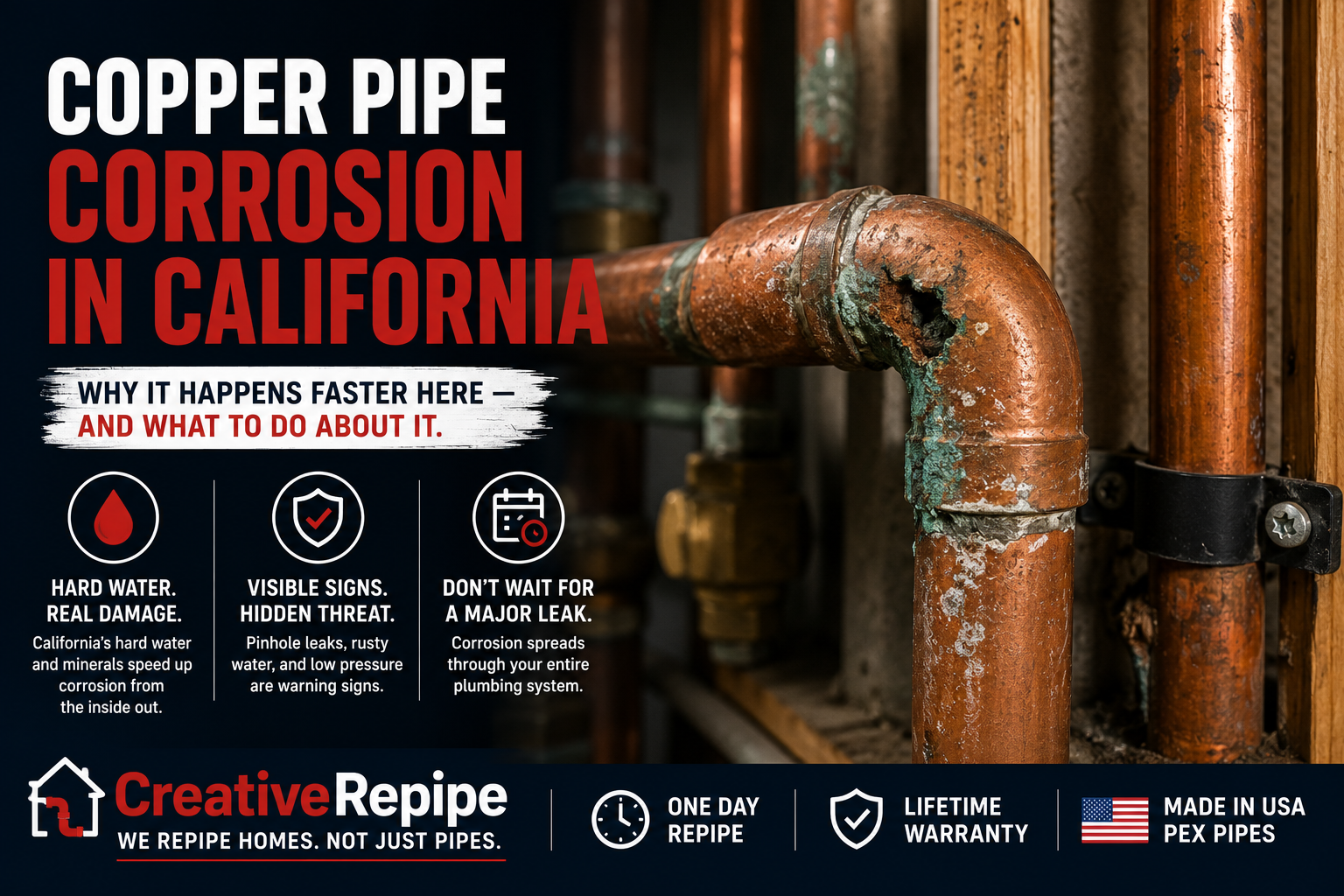
Copper Pipe Corrosion in California: Why It Happens Faster Here — and What to Do About It
Copper pipe corrosion in California is not the same process that plays out in softer water states. The national average lifespan for copper pipe is 50 to 70 years. In California’s specific water environment, however, many homes show active corrosion-related failures well before that benchmark — sometimes decades earlier.
Understanding why helps homeowners recognize the warning signs and make smarter decisions about when to act. Here is the full picture.
What Copper Pipe Corrosion Actually Is
Copper pipe corrosion is not rust in the traditional sense. Copper does not contain iron, so it does not produce the red-orange rust most people associate with failing metal. Instead, copper deteriorates through a different process — and California’s water supply makes that process significantly more aggressive than in most other parts of the country.
The most common form of copper pipe corrosion in California homes is called pitting corrosion. Tiny pits form on the interior surface of the pipe wall, driven by chemical reactions between the copper and the water flowing through it. Those pits deepen slowly over years until one finally breaks through the pipe wall entirely — producing a pinhole leak that appears without warning.
By the time that first pinhole appears, however, pitting corrosion has typically been active throughout the entire pipe system for years. The visible leak is not the beginning of the problem. It is simply the first point where the damage broke through.
Why California’s Water Accelerates Copper Pipe Corrosion
Two specific characteristics of California’s municipal water supply make copper pipe corrosion happen faster here than in most other states.
Hard water mineral content. California water carries high concentrations of dissolved calcium and magnesium. Those minerals do not directly corrode copper in the same way chloramine does. However, they deposit as scale on pipe interiors over time. That scale creates rough surface conditions that accelerate the pitting process and also narrow the pipe, gradually reducing flow and pressure throughout the home.
Chloramine disinfection. This is the primary driver of accelerated copper pipe corrosion in California. Water utilities throughout the state use chloramine as a disinfectant rather than plain chlorine. Chloramine is more chemically stable than chlorine — but that stability comes at a cost. It reacts with copper pipe walls more aggressively and over a longer sustained period, driving the pitting corrosion process from the inside out at a faster rate than plain chlorinated water does.
The combination of these two factors creates a water environment that is particularly hard on copper pipe. Consequently, California homes built in the 1970s and 1980s — with copper systems now 40 to 55 years old — are showing corrosion failure patterns that the 50 to 70 year national average does not fully account for.
For a deeper look at how hard water affects all metal pipe systems throughout California, read this → The Hidden Cost of Hard Water in Orange County
The Different Types of Copper Pipe Corrosion
Not all copper pipe corrosion in California homes looks the same. Several distinct corrosion types show up in our evaluations, and each one gives different information about what is happening inside the system.
Pitting corrosion. The most common type in California. Small, deep pits form on the interior pipe surface driven primarily by chloramine exposure. Pitting corrosion produces pinhole leaks and slab leaks. It is often invisible from the outside until a section fails entirely.
Erosion corrosion. This type occurs when water flows at high velocity through the pipe, wearing away the interior surface over time. It appears most often at bends, fittings, and narrow sections where water changes direction. Homes with unusually high water pressure or aggressive water flow patterns are more susceptible.
Galvanic corrosion. This type occurs when copper pipe makes direct contact with a dissimilar metal without proper insulation between them. The two metals create a small electrical current that accelerates corrosion at the contact point. It is particularly common in older homes where copper was connected directly to galvanized steel during partial upgrades.
Microbiologically influenced corrosion (MIC). Less common but worth noting. Certain bacteria in water systems can accelerate copper corrosion under specific conditions. MIC typically produces distinctive pit patterns and is more common in water systems with low disinfectant levels.
Warning Signs of Copper Pipe Corrosion in Your Home
Copper pipe corrosion sends recognizable signals before a major failure occurs. Watch for these specifically in an older California home.
Blue-green staining around fittings and fixtures. Copper oxide — the byproduct of corrosion — produces a distinctive blue-green color where it deposits on surfaces around pipe connections, faucet bases, and drain openings. This staining is one of the earliest visible signs of active corrosion.
Pinhole leaks. Small, seemingly isolated leaks that appear without a clear cause are the classic symptom of pitting corrosion breaking through a pipe wall. One pinhole leak is a warning. Two or more within a short period signals system-wide deterioration.
Declining water pressure across the home. Scale buildup from hard water combined with corrosion debris narrows pipe interiors over time, restricting flow throughout the entire system. Pressure loss that affects multiple fixtures simultaneously points directly at the pipe system rather than individual fixtures.
Discolored water. A slight blue or greenish tint in water, or water with a metallic taste, can indicate elevated copper levels from active corrosion. This symptom is worth taking seriously and investigating promptly.
For a full checklist of warning signs that a repipe may be overdue, read this → 5 Signs Your Orange County Home Is Quietly Telling You It Needs a Repipe
How Long Before Copper Pipe Corrosion Causes Failure in California?
The timeline varies by neighborhood, water district, and the specific copper grade installed. However, some general patterns emerge consistently from our evaluations throughout California.
Homes built before 1970 with original copper plumbing are often past the point where repairs make financial sense. Active leaks and system-wide deterioration are common findings in evaluations of homes from this era.
Homes from the 1970s and early 1980s sit in the peak failure window right now. Pitting corrosion that began decades ago is producing its first visible failures throughout these systems — and once the first pinhole appears, additional failures elsewhere in the same system typically follow within months to a few years.
Homes from the late 1980s and early 1990s are entering the early warning phase. Pressure loss and occasional discoloration are often the first signals. The pitting process is active, though full failures may still be years away.
For a full era-by-era breakdown of copper pipe lifespan in California, read this → How Long Do Copper Pipes Last?
Why PEX Solves the Copper Corrosion Problem Permanently
When California homeowners replace a corroding copper system, the choice of replacement material determines whether the same problem returns decades later.
Replacing copper with copper installs new pipe — but new pipe that faces the exact same chloramine and hard water chemistry that caused the original system to corrode. The corrosion cycle starts again from day one, just with a longer countdown.
PEX breaks that cycle entirely. It is chemically inert. Chloramine does not react with PEX. Hard water minerals do not corrode it. The pitting corrosion mechanism that destroys copper in California’s water environment simply does not apply to PEX.
The PEX our team installs carries a 100+ year rating — not because PEX is inherently more durable than copper in ideal conditions, but because the specific failure mechanism affecting copper in California has no equivalent effect on PEX whatsoever.
For a full comparison of how copper and PEX perform differently in California’s water environment, read this → Copper Pipe Lifespan vs PEX
What Replacing a Corroding Copper System Costs in California
For most standard single-family homes, a whole-home repipe with Creative Repipe costs between $6,000 and $14,000. Our team provides a firm price after a free in-home evaluation — never a phone estimate. Most homes wrap up in one to two days, with water restored each evening and drywall patched when the job is complete.
Every repipe includes a Lifetime Transferable Warranty. Additionally, we beat any written quote from a licensed competitor.
Get a Free Evaluation Before the Next Pinhole Appears
Our team assesses your copper system, identifies the extent of corrosion, and gives you a straight recommendation on whether a targeted repair or a full repipe makes more financial sense for your specific home.
Call Creative Repipe at (888) 373-0046 Or CLICK HERE to receive your free estimate.
Frequently Asked Questions
Why does copper pipe corrode faster in California than other states?
California’s municipal water combines high mineral content with chloramine disinfection. Chloramine reacts with copper walls more aggressively than plain chlorine, driving pitting corrosion from the inside out at an accelerated rate. The result is that California copper systems often fail well before the 50 to 70 year national average.
What does copper pipe corrosion look like from the outside?
Blue-green staining around fittings and fixtures is the most visible external sign. Pinhole leaks, declining water pressure throughout the home, and slight discoloration or metallic taste in the water are the most common symptoms.
Can corroded copper pipes be repaired instead of replaced?
Individual pinhole leaks can be repaired. However, pitting corrosion affects the entire pipe system equally — not just the section that has already failed. Repairing one point typically leads to additional failures elsewhere within months to a few years.
How do I know if my copper pipes have pitting corrosion?
Pinhole leaks in different locations, blue-green staining around fittings, declining pressure across multiple fixtures, and a metallic taste in the water are the most reliable indicators. A free in-home evaluation confirms the extent of corrosion throughout the system.
What is the best replacement for corroded copper pipe in California?
PEX is our most recommended choice. It is chemically inert and completely unaffected by the chloramine and hard water chemistry that causes copper to corrode in California. The PEX our team installs carries a 100+ year rating.
How much does copper pipe corrosion repair cost versus full replacement?
Individual repairs cost $1,500 to $3,500 per leak. A full whole-home repipe with Creative Repipe costs $6,000 to $14,000. For homes with multiple corrosion-related failures, the cumulative repair cost often approaches or exceeds the repipe cost — without solving the root problem.
0 Comments