

How Long Do Copper Pipes Last? The Real Answer for California Homeowners
How long do copper pipes last is one of the most searched plumbing questions in California — and the standard answer most people find online does not tell the full story.
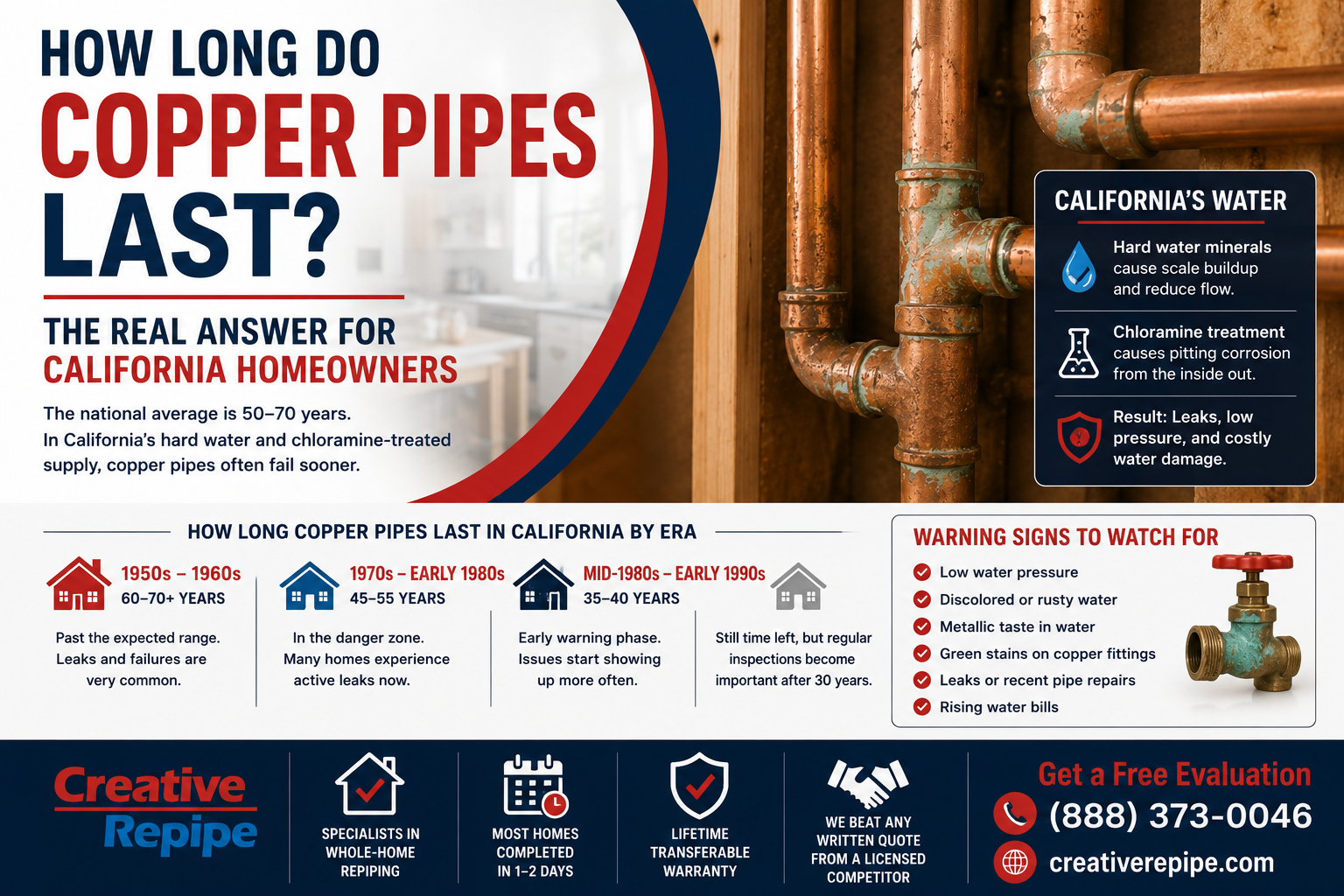
The industry average says 50 to 70 years. That number applies to copper pipe in average water conditions. California does not have average water conditions. The combination of hard municipal water and chloramine disinfection creates an environment that shortens copper’s functional lifespan in ways most homeowners only discover after the first leak shows up.
Here is the honest answer, specific to California.
The National Average vs. The California Reality
Copper pipe earned its 50 to 70 year reputation in regions with soft, relatively neutral water. In those conditions, the material holds up well and the lifespan estimate is reasonable.
California tells a different story. Municipal water throughout most of the state — particularly in Southern California — carries high concentrations of dissolved minerals including calcium and magnesium. That mineral load deposits as scale on the interior walls of copper pipes over time, gradually narrowing the pipe and reducing flow.
On top of that, water treatment in California relies heavily on chloramine. Unlike plain chlorine, chloramine reacts with copper at the molecular level through a process called pitting corrosion. Tiny pits form on the interior pipe wall from the inside out, growing deeper with each passing year until one finally breaks through.
The result is that copper pipes in California communities with hard water often show active failure patterns well before the 50 year mark. Homes built in the 1970s are showing consistent leaks. Homes from the 1980s are entering that window right now.
How Long Copper Pipes Last by Era in California
The age of a home gives a useful starting point for understanding where its copper plumbing stands today.
Homes built in the 1950s and 1960s These systems are now 60 to 70 years old. Original copper in this age range has been carrying California’s hard water for longer than the material was ever designed to handle in these conditions. Active leaks, slab leaks, and significant pressure loss are common findings in homes from this era. Replacement is rarely a question of if — it is a question of when.
Homes built in the 1970s and early 1980s These systems are 45 to 55 years old and squarely in the window where California’s water chemistry produces the most consistent failure patterns. Pinhole leaks, slab leaks, and gradually declining pressure across the home are all common at this age. A free evaluation is strongly recommended before the next leak occurs rather than after.
Homes built in the mid-1980s through early 1990s These systems are now 35 to 40 years old. Many are entering the early warning phase — declining pressure, occasional discoloration, and the first isolated leaks beginning to appear. The failure curve accelerates from here.
Homes built after 1995 Copper in these homes still has time in most California water districts, though coastal cities and areas with particularly hard water can accelerate the timeline. A periodic evaluation every few years becomes worth scheduling as these homes cross the 30 year mark.
Warning Signs That Copper Is Reaching the End of Its Lifespan
Copper pipe sends recognizable signals before it fails completely. Watch for these in your home:
- Water pressure dropping gradually across multiple fixtures
- Orange or brown water, especially from taps that have not been used recently
- A faint metallic taste that was not present before
- Green or blue-green staining around pipe fittings or connections
- One or more pinhole leaks or recent pipe repairs
- A water bill that keeps creeping up without a clear reason
Any two of these together in a home with original copper plumbing built before 1990 is a strong signal to schedule an evaluation before the next failure happens on its own schedule.
For a complete checklist of warning signs across all pipe types, read this → Is It Time to Repipe My House?
Does the Type of Copper Matter?
Not all copper pipe is the same thickness. Two grades appear most commonly in California residential construction.
Type M copper, the thinner grade, was widely used in tract home construction throughout California during the 1960s, 1970s, and 1980s. Thinner walls mean less material for corrosion to work through before a pinhole develops. Many of the homes showing the most active failure patterns in Orange County and the surrounding region have Type M copper.
Type L copper, the heavier grade, was used in higher-end construction and is more common in commercial applications. It holds up longer under the same water conditions because there is simply more wall thickness for corrosion to work through.
If you are unsure which type is in your home, a professional evaluation confirms it quickly.
What Happens After Copper Pipes Reach the End of Their Life
Homeowners typically face two paths once copper plumbing starts showing consistent failures.
The repair path involves fixing individual leaks as they appear. Each repair costs $1,500 to $3,500 depending on location and accessibility. The underlying system continues aging throughout that process, and the interval between repairs tends to shorten over time.
The repipe path replaces the entire supply system at once. New PEX or copper lines go in throughout the home, every connection point is fresh, and the failure cycle stops entirely. Most California homes are completed in one to two days.
For most homeowners who have already had more than one repair, the math increasingly favors replacement. The pipes that keep failing are not isolated problems — they are symptoms of a system that has reached the end of its lifespan in California’s specific water environment.
For a detailed look at how repair costs compare to repipe costs, read this → Why Orange County Homeowners Are Overpaying for Repipes
What Replacing Copper Pipes Costs in California
For most standard single-family homes, a whole-home repipe with Creative Repipe runs between $6,000 and $14,000. The final number depends on square footage, number of bathrooms, and whether PEX or copper is chosen for the replacement material.
We provide a firm price after a free in-home evaluation — never a phone estimate. Most homes are completed in one to two days, with water restored each evening and drywall patched when the job is finished. Every repipe includes a Lifetime Transferable Warranty.
Get a Free Evaluation Before the Next Leak Decides for You
We assess your copper system, identify the material grade and condition, and give you a straight answer on where things stand and what replacement would involve.
Call Creative Repipe at (888) 373-0046 Or CLICK HERE to receive your free estimate.
Frequently Asked Questions
How long do copper pipes typically last in California?
California’s hard water environment, copper pipes often show active failure patterns before the 50 year mark that defines the national average. Homes with original copper built in the 1970s and 1980s are currently in the highest-risk window.
Why does California water shorten copper pipe lifespan?
Two factors combine to accelerate corrosion. High mineral content in California municipal water deposits scale on pipe interiors, narrowing flow over time. Chloramine treatment reacts with copper walls through pitting corrosion, thinning the pipe from the inside out until pinhole leaks develop.
Does the type of copper pipe affect how long it lasts?
Yes. Type M copper, the thinner grade used widely in California tract home construction, deteriorates faster than Type L copper under the same water conditions simply because there is less wall thickness for corrosion to work through.
Can copper pipes be repaired instead of replaced?
Individual leaks can be repaired, and that makes sense for isolated failures in younger systems. For homes with multiple leaks or consistent failure patterns, the cumulative repair cost often approaches the cost of a full repipe while leaving the aging system in place.
What is the best replacement material for copper pipes in California?
PEX is the most common choice because it is chemically inert — completely unaffected by the mineral content and chloramine treatment that causes copper to fail in California. It carries a 100+ year rating under normal residential conditions. Copper remains a strong option for homeowners who prefer it.
How much does it cost to replace copper pipes in a California home?
For most standard single-family homes, Creative Repipe completes whole-home repiping for $6,000 to $14,000, with a firm number provided after a free in-home evaluation.
0 Comments