

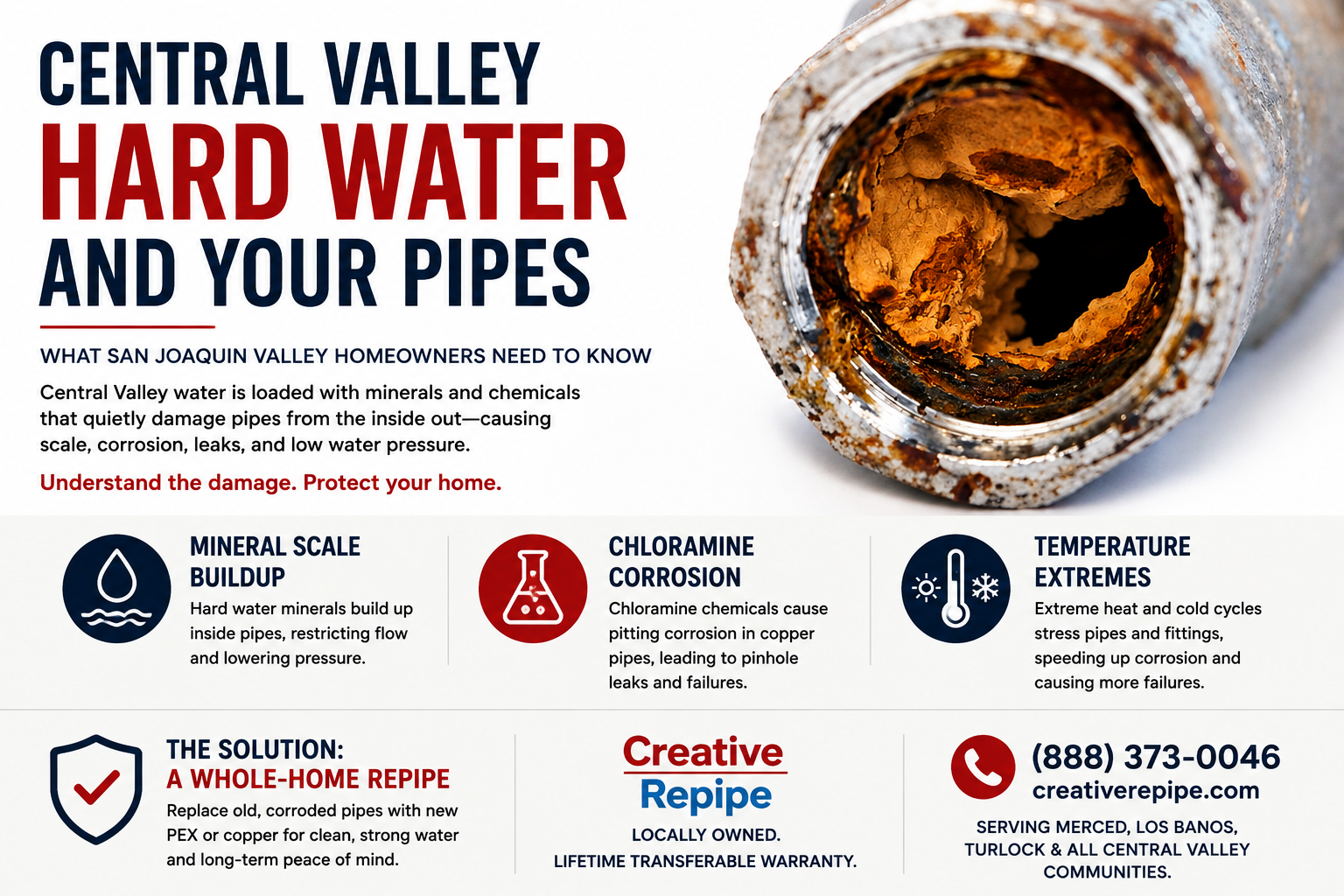
Central Valley Hard Water and Your Pipes: What San Joaquin Valley Homeowners Need to Know
Central Valley hard water pipes is a combination that tells a specific story — one that most homeowners in Los Banos, Merced, Turlock, and the surrounding San Joaquin Valley communities have never fully understood. The water coming through their taps looks clear. It tastes fine. However, it has been quietly attacking the metal pipe systems in their homes for decades — and the failures showing up throughout the region right now are the predictable result of that invisible process.
Here is what Central Valley hard water actually does to residential pipe systems — and what homeowners can do about it before a leak forces the decision.
Why Central Valley Water Is Exceptionally Hard
California has hard water throughout most of the state. However, the San Joaquin Valley carries some of the hardest municipal and residential water in the entire country — not just California.
The reason is geology and agriculture. The Central Valley sits in a vast basin surrounded by mountain ranges. Water flowing into the valley — from the Sierra Nevada snowpack, the San Joaquin River, and local groundwater wells — picks up dissolved minerals as it travels through agricultural soils rich in calcium, magnesium, and other compounds. By the time that water reaches a residential tap in Los Banos or Merced, it carries a mineral load significantly higher than what coastal California cities receive from their water supplies.
Additionally, water treatment throughout the Central Valley uses chloramine as a disinfectant. Chloramine is more persistent than plain chlorine — and that persistence means it reacts with metal pipe walls over a longer sustained period. The combination of extremely high mineral content and aggressive chloramine chemistry creates a water supply that is particularly destructive to copper and galvanized pipe systems over time.
What Hard Water Actually Does to Metal Pipes
Hard water affects pipe systems through two distinct mechanisms. Understanding both helps homeowners recognize what is happening long before a leak makes it obvious.
Scale buildup on pipe interiors. Dissolved calcium and magnesium in hard water deposit on the inside walls of metal pipes as water flows through them. That deposit — called limescale — accumulates gradually over years, narrowing the effective interior diameter of the pipe. Water flows more slowly. Pressure drops throughout the home. Showers feel weaker. Appliances connected to the water supply run less efficiently. In the Central Valley’s extremely hard water environment, scale buildup tends to be more severe and faster-developing than in coastal California cities with softer water supplies.
Chloramine-driven pitting corrosion. This mechanism specifically targets copper pipe. Chloramine reacts with the copper surface through an electrochemical process that creates tiny pits on the pipe interior. Those pits deepen over years of continuous exposure, thinning the copper wall from the inside until one finally breaks through — producing a pinhole leak. By the time that first pinhole appears, pitting has typically been active throughout the entire pipe system for years. The visible leak is not the start of the problem. It is simply the first point where the damage broke through.
For a deeper look at how pitting corrosion works specifically in California homes, read this → Copper Pipe Corrosion in California
What Hard Water Does to Galvanized Pipe in the Central Valley
For older Central Valley homes with galvanized steel pipe — common throughout Los Banos and Merced neighborhoods built before the 1960s — hard water produces a related but distinct failure process.
Galvanized pipe was coated with zinc to protect the steel beneath. Hard water minerals react with that zinc coating over time, accelerating the breakdown that exposes the steel to rust. In the Central Valley’s extremely hard water environment, that breakdown happens faster than in softer water regions. Once the zinc is gone, rust builds steadily on the pipe interior — narrowing the pipe, contaminating the water with iron particles, and eventually producing leaks throughout the system.
Brown or rust-colored water is the most visible symptom. However, by the time that symptom appears consistently, the galvanized system has typically been actively deteriorating for a decade or more. For a full look at the warning signs that a galvanized system is approaching failure, read this → Signs of Galvanized Pipe Failure
The Central Valley Temperature Factor
Central Valley hard water does not work alone. Extreme temperature swings throughout the San Joaquin Valley add a mechanical stress factor that coastal California homeowners rarely have to manage.
Summer temperatures in Los Banos, Merced, and Turlock regularly exceed 100 degrees. Winter nights can drop near freezing. That dramatic thermal cycling — pipes expanding in summer heat and contracting in winter cold — puts repeated mechanical stress on fittings and connection points throughout the life of the pipe system.
For systems already weakened by years of hard water corrosion, that thermal stress accelerates failure. A fitting that might hold for another decade in a moderate coastal climate may fail in two or three years under the thermal cycling conditions that the Central Valley produces annually.
Why Flushing and Filtering Do Not Solve the Problem
Many Central Valley homeowners install whole-house water softeners or filters to address hard water. Those systems improve water quality at the tap — and in some cases, they can slow the scale buildup on pipe interiors going forward.
However, softeners and filters do not reverse the corrosion that has already occurred inside the pipe. A galvanized system that has been deteriorating for 60 years does not recover because a softener is installed. The existing rust buildup and pipe wall thinning remain. The structural weakness at the fittings and connection points remains.
Additionally, chloramine corrosion in copper pipe is not addressed by water softening. Softeners remove calcium and magnesium — not chloramine. Consequently, pitting corrosion in copper pipe continues even in homes with softened water, because the chloramine in the municipal supply is unaffected by the softening process.
Why PEX Is the Right Answer to Central Valley Hard Water
The most important thing to understand about PEX and Central Valley hard water is straightforward: PEX does not react to any of it.
Calcium and magnesium do not deposit on PEX interiors the way they deposit on metal pipe. Chloramine passes through PEX without triggering pitting corrosion. And PEX’s natural flexibility handles the thermal cycling that the Central Valley’s temperature extremes produce — absorbing expansion and contraction at fittings rather than transmitting that stress directly to connection points.
The PEX we install carries a 100+ year rating. In the Central Valley’s aggressive hard water and thermal cycling environment, that rating reflects a material that simply does not have the failure mechanisms that destroy copper and galvanized pipe here. Replacing an aging metal system with PEX breaks the cycle permanently — not temporarily.
For a full comparison of how PEX and copper perform differently in California’s hard water environments, read this → Copper Pipe Lifespan vs PEX
Warning Signs That Central Valley Hard Water Has Damaged Your Pipes
Watch for these signals in your San Joaquin Valley home — particularly if the home was built before 1985.
- Water pressure dropping gradually across the entire home
- Orange, brown, or rust-colored water — especially first thing in the morning
- A faint metallic taste that was not present before
- White or yellowish scale buildup around faucets, drains, and showerheads
- Recurring pinhole leaks or slab leaks in different locations
- A water bill climbing without a clear explanation
Any two of these together in a home with original metal plumbing is a strong signal to schedule a free evaluation before the next failure arrives on its own schedule.
For a full checklist of warning signs across all pipe types, read this → Is It Time to Repipe My House?
What a Repipe Costs in the Central Valley
For most standard single-family homes in Los Banos, Merced, Turlock, and surrounding Central Valley communities, a whole-home repipe with Creative Repipe costs between:
$6,000 to $14,000
That covers complete hot and cold water line replacement, all angle stops and supply lines replaced, and professional drywall patching when the job is done. Most Central Valley homes are completed in one to two days, with water restored at the end of each working day. Every repipe includes a Lifetime Transferable Warranty.
Our team provides a firm number after a free in-home evaluation — never a phone estimate. Additionally, we beat any written quote from a licensed competitor.
Schedule Your Free Central Valley Evaluation
Our team serves Los Banos, Merced, Turlock, and the surrounding San Joaquin Valley communities. We come to your home, assess your full plumbing system, and give you a straight answer on repair or repipe — real pricing, no pressure.
Call Creative Repipe at (888) 373-0046 Or CLICK HERE to receive your free estimate.
Frequently Asked Questions
Is Central Valley water really harder than other parts of California?
Yes. San Joaquin Valley water carries some of the highest dissolved mineral content in the entire country — not just California. Agricultural soils rich in calcium and magnesium, combined with groundwater that picks up minerals as it travels through the valley basin, produce a water supply significantly harder than coastal California cities receive.
Does a water softener fix the pipe damage caused by Central Valley hard water?
No. A softener can slow future scale buildup on pipe interiors but does not reverse existing corrosion. It also does not address chloramine-driven pitting corrosion in copper pipe, since chloramine is unaffected by the softening process.
How does Central Valley hard water compare to coastal California hard water?
Both carry high mineral content and chloramine disinfection. However, Central Valley water tends to carry higher mineral loads from agricultural groundwater sources. Additionally, Central Valley homes face extreme thermal cycling that coastal homes do not — adding a mechanical stress factor that accelerates corrosion-driven failures.
How much does a repipe cost in the Central Valley?
For most standard single-family homes in Los Banos, Merced, Turlock, and surrounding communities, Creative Repipe completes whole-home repiping for $6,000 to $14,000. Our team provides a firm price after a free in-home evaluation.
Does Creative Repipe serve the San Joaquin Valley?
Yes — our team serves Los Banos, Merced, Turlock, and all surrounding Central Valley communities as part of our expanded California service area.
What warranty does Creative Repipe offer?
Every whole-home repipe includes a Lifetime Transferable Warranty — no expiration date, no fine print, and it transfers to the new owner if you sell.
0 Comments