

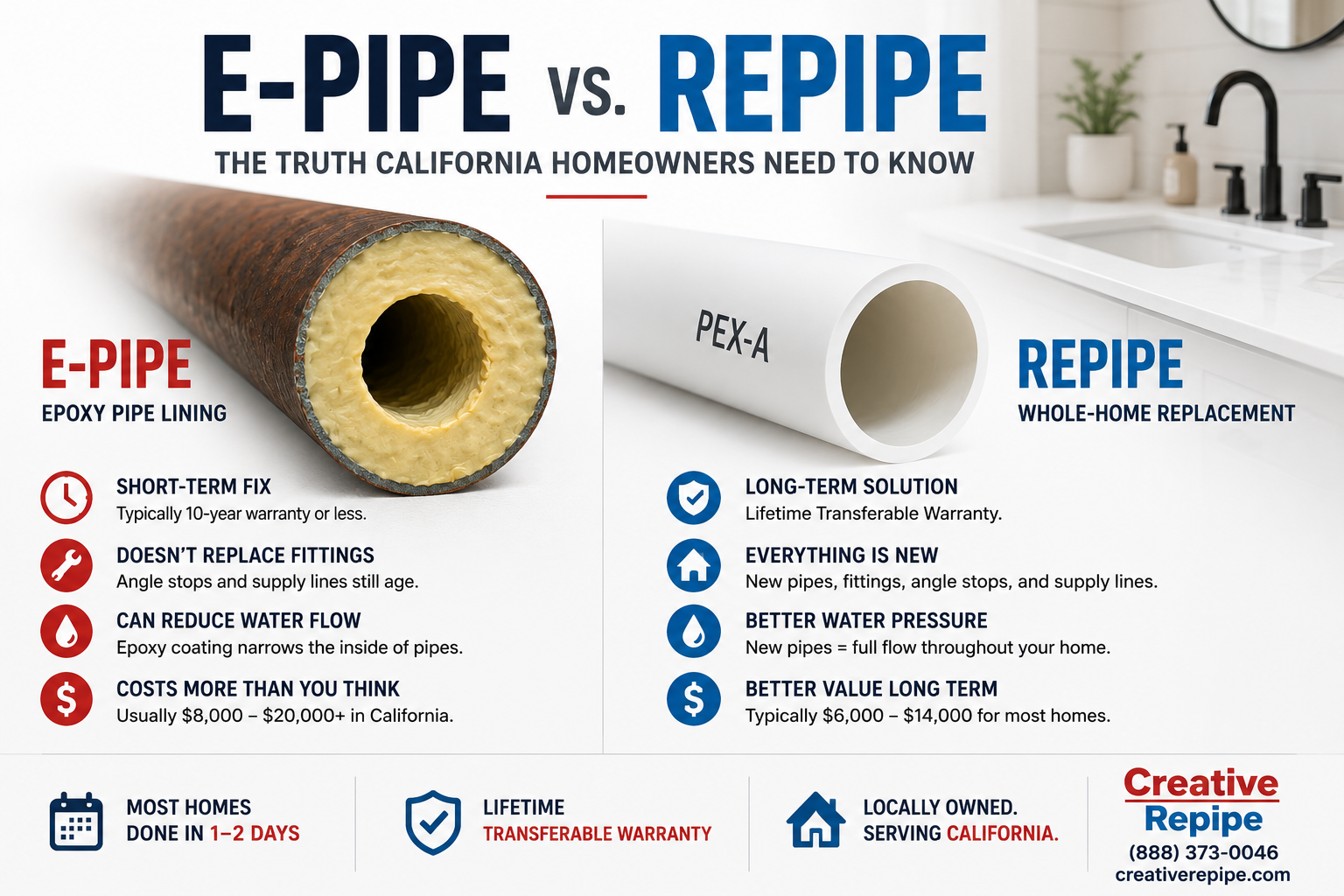
E-Pipe vs Repipe: The Truth About Epoxy Pipe Lining California Homeowners Need to Know
E-pipe vs repipe is a comparison more California homeowners are facing as epoxy pipe lining companies expand their marketing throughout the state. The pitch sounds appealing — coat the inside of your existing pipes with epoxy and avoid the mess of a full replacement. No walls opened. No drywall patching. Done in a day.
However, the reality of e-pipe does not always match that pitch. Here is an honest, side-by-side comparison of both options so you can make the right call before spending money on either one.
What E-Pipe Actually Is
E-pipe — short for epoxy pipe lining — is a process that coats the interior of existing pipes with a layer of epoxy resin. The goal is to seal small pinholes and slow further corrosion by creating a barrier between the pipe wall and the water flowing through it.
The process typically involves cleaning the existing pipes, then blowing or pulling liquid epoxy through them so it coats and cures on the interior surface. The existing pipe stays in place. Nothing gets removed or replaced.
E-pipe is sometimes also called pipe lining, pipe coating, or cured-in-place pipe. The names vary by company, but the process is essentially the same.
What a Whole-Home Repipe Actually Is
A whole-home repipe removes the existing pipe system entirely and installs new supply lines throughout the home. Every hot and cold supply run, every angle stop, and every supply connection at every fixture gets replaced with new material — typically PEX or copper.
The old pipes are gone. The new system starts fresh, with no corrosion history, no scale buildup, and no coating that could fail or peel over time.
For a full breakdown of what a repipe includes, read this → What Is a Whole Home Repipe?
Where E-Pipe Falls Short in California
E-pipe works best in specific, limited situations — large commercial drain lines, municipal sewer rehabilitation, and industrial applications where full replacement is impractical. In those contexts, it is a reasonable tool.
In California residential homes, however, e-pipe faces several challenges that limit its value significantly.
It only addresses the pipe interior — not the fittings. Most pinhole leaks and slab leaks in California homes originate at or near fittings, joints, and connection points — not in the straight runs of pipe between them. Epoxy lining coats the straight sections well, but getting consistent coverage into fittings, elbows, and connection areas is difficult. As a result, the most common failure points in a corroding California pipe system often go untreated.
It does not replace angle stops or supply lines. A whole-home repipe includes every angle stop under every sink and behind every toilet, plus all supply lines to every fixture. E-pipe touches none of these. Those components continue aging on their original timeline.
The coating has a limited lifespan. Epoxy lining in residential supply lines typically carries a warranty of 10 years or less. A whole-home repipe with Creative Repipe includes a Lifetime Transferable Warranty. That is a meaningful difference for any homeowner thinking about long-term value.
It can affect water flow. Epoxy coating adds a thin layer to the interior of the pipe. In pipes that are already narrowed from years of scale buildup, that additional layer can further restrict flow. Some homeowners report lower water pressure after e-pipe treatment, not better pressure.
It costs more than most homeowners expect. E-pipe is often marketed as a budget-friendly alternative to repiping. However, quotes for residential e-pipe in California frequently run $8,000 to $20,000 or more — often approaching or exceeding the cost of a full repipe with Creative Repipe. For that price, a full repipe delivers a genuinely new system rather than a coating on an old one.
Where E-Pipe Can Make Sense
To be fair, e-pipe is not without merit in specific situations.
If a home has pipes embedded in walls or ceilings that are genuinely impossible to access for replacement — in certain historic properties, concrete structures, or commercial buildings — e-pipe offers a way to extend the functional life of those pipes without major construction.
Additionally, for homeowners who need a temporary solution while planning a longer-term replacement, e-pipe can buy time. However, it should be understood as a delay rather than a fix.
For most standard California residential homes with accessible wall cavities and attic spaces, a full repipe is both more practical and more cost-effective than e-pipe over any meaningful time horizon.
The Honest Cost Comparison
Here is how the two options stack up in real California pricing.
E-pipe in a standard California home: Typically $8,000 to $20,000 depending on the scope and company. Warranty: usually 10 years or less. What you get: a coating on an old system with aging fittings and connections still in place.
Whole-home repipe with Creative Repipe: $6,000 to $14,000 for most standard single-family homes. Warranty: Lifetime Transferable. What you get: a completely new supply system, every fitting replaced, every connection fresh, PEX rated 100+ years.
For most California homeowners, the numbers do not favor e-pipe — especially when the long-term value of each option is considered.
For a full breakdown of what drives repipe pricing in California, read this → Repipe Cost in California 2026
Questions to Ask Before Agreeing to E-Pipe
If a company has quoted you e-pipe and you are weighing the decision, ask these questions directly before signing anything.
Does the quote include the fittings and connection points — or just the straight pipe runs? What is the warranty length, and what does it actually cover? How does the price compare to a full repipe quote from a licensed repipe specialist? Will the epoxy affect water pressure in pipes that already have scale buildup?
A company confident in their product will answer all four clearly. Vague answers on any of them are worth noting.
What We Recommend — and Why We Are Honest About It
At Creative Repipe, we do not offer e-pipe. We specialize exclusively in whole-home repiping. So it would be easy to dismiss e-pipe entirely for competitive reasons.
However, the comparison above reflects what we genuinely believe — that for most California residential homes, a full repipe delivers more value, more protection, and a longer warranty at a price that is often lower than e-pipe quotes from the same market.
That said, if a home has a specific access limitation that makes e-pipe the only practical option, we say so during the free evaluation rather than pushing a full repipe where it is not the right fit.
For more on what separates a trustworthy repipe company from one that sells the wrong solution, read this → How to Choose a Repipe Company
Schedule Your Free Evaluation
Our team comes to your home, assesses your full plumbing system, and gives you a straight recommendation — e-pipe, repipe, or repair, depending on what your home actually needs.
Call Creative Repipe at (888) 373-0046 Or CLICK HERE to receive your free estimate.
Frequently Asked Questions
Is e-pipe better than a full repipe for a California home?
For most California residential homes, a full repipe delivers more value. E-pipe coats the interior of existing pipes but does not replace fittings, angle stops, or supply lines — the most common failure points in aging California systems. Additionally, e-pipe warranties typically run 10 years or less, compared to the Lifetime Transferable Warranty included with every Creative Repipe job.
How much does e-pipe cost compared to a repipe in California?
E-pipe in a standard California home typically runs $8,000 to $20,000. A whole-home repipe with Creative Repipe costs $6,000 to $14,000 for most standard homes. For most homeowners, the full repipe delivers significantly more value at a comparable or lower price.
Does e-pipe fix slab leaks?
E-pipe can seal small pinholes in straight pipe runs. However, most slab leaks in California originate at or near fittings and connection points where consistent epoxy coverage is difficult to achieve. A full repipe with above-slab rerouting eliminates the slab pipe system entirely, preventing future slab leaks.
Will e-pipe affect my water pressure?
Potentially. Epoxy adds a layer to the pipe interior. In pipes already narrowed by years of scale buildup, that additional layer can further restrict flow. Some California homeowners report lower pressure after e-pipe treatment.
How long does e-pipe last?
Most residential e-pipe warranties run 10 years or less. The PEX installed by Creative Repipe carries a 100+ year rating, backed by a Lifetime Transferable Warranty with no expiration date.
When does e-pipe actually make sense?
E-pipe makes the most sense in situations where pipe access is genuinely limited — certain historic properties, commercial structures, or embedded concrete applications where full replacement is not practical. For most standard California residential homes with accessible wall cavities and attic spaces, a full repipe is the more cost-effective and durable solution.
0 Comments