

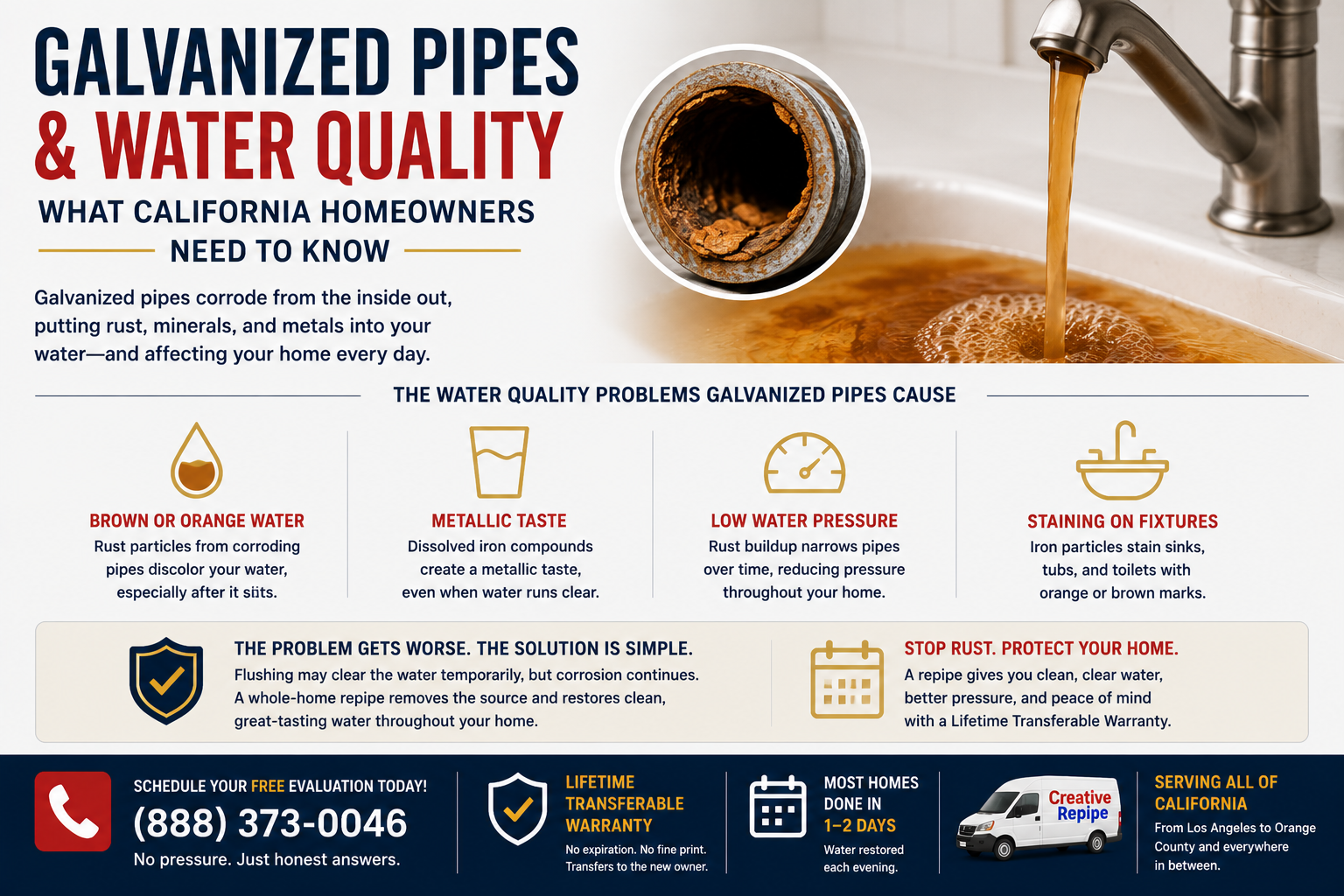
Galvanized Pipes and Water Quality: What California Homeowners Need to Know
Galvanized pipe water quality problems are among the most commonly misdiagnosed issues in older California homes. Homeowners notice rust-colored water, a metallic taste, or low pressure and assume the problem is coming from the city supply. In most cases, however, the city supply is perfectly fine. The problem lives inside the walls.
Here is what galvanized pipes actually do to your water — and why the solution goes well beyond running the tap and hoping it clears.
What Galvanized Pipe Does to Your Water Over Time
Galvanized steel pipe was coated with zinc to resist corrosion when manufacturers produced it. That coating worked well for decades. In California’s hard water environment, however, the zinc gradually reacts with mineral-heavy municipal water and wears away over time.
Once the zinc is gone, the exposed steel beneath begins to rust. That rust does not stay in place — it breaks loose in flakes and particles that enter your water supply every time you turn on a tap. Additionally, rust builds steadily on the interior walls of the pipe itself, narrowing the effective diameter and restricting flow throughout the home.
The result is water that carries rust particles, iron compounds, and mineral deposits directly to your faucets, showers, and appliances.
Four Specific Water Quality Problems Galvanized Pipe Creates
Galvanized pipe water quality issues show up in four distinct ways. Each one points to the same underlying cause.
Brown or orange water. Rust particles from the corroding pipe interior turn water orange or brown — particularly after water has been sitting in the pipes overnight. The discoloration varies in intensity depending on how far the corrosion has progressed.
Metallic taste. Even when water runs clear, dissolved iron compounds from corroding galvanized pipe produce a distinct metallic taste. Many homeowners blame their fixtures or the city supply. However, the source is almost always the pipe material itself.
Low water pressure. As rust accumulates on pipe interiors over decades, the effective interior diameter shrinks. Water flows more slowly, pressure drops throughout the home, and showers feel noticeably weaker. This pressure loss happens gradually enough that many homeowners adapt without connecting it to the pipe system.
Fixture staining. Orange or brown staining in sinks, bathtubs, and toilets is a direct result of iron particles in the water supply. The staining appears most prominently around drains and faucets where water sits or flows regularly.
Is Water From Galvanized Pipes Safe to Drink?
This is the first question most homeowners ask — and it deserves a direct answer.
Occasional rust-colored water from momentarily disturbed sediment is generally not an acute health emergency. Consistently drinking water that carries rust particles, iron compounds, and scale debris from a corroding galvanized system, however, is not what California’s municipal water was designed to deliver.
More importantly, the water quality symptoms are telling you something critical about your pipe’s structural condition. Consistent rust in your water means active corrosion throughout the system. That corrosion leads to leaks — and leaks in aging galvanized systems tend to appear in multiple locations over a short period.
In other words, the water quality problem and the plumbing reliability problem are the same problem.
Why California’s Water Accelerates Galvanized Pipe Corrosion
California’s municipal water makes galvanized pipe deterioration faster than in many other parts of the country. Two factors drive that acceleration specifically.
Hard water mineral content is the first. California water carries high concentrations of calcium and magnesium. Those minerals react with both the zinc coating and the exposed steel beneath it, speeding up the corrosion process from the inside.
Chloramine treatment is the second. California water utilities use chloramine as a disinfectant rather than plain chlorine. Chloramine is more chemically stable — but it also reacts with metal pipe surfaces more aggressively over time. Consequently, galvanized pipe in California water districts deteriorates faster than identical pipe would in a softer water environment.
For a broader look at what California’s hard water does to all metal pipe systems, read this → The Hidden Cost of Hard Water in Orange County
Why Flushing the Pipes Does Not Solve the Problem
Many homeowners run their taps for several minutes when they notice rusty water. That temporarily clears loose sediment and can improve water appearance briefly. It does not, however, address the source of the problem.
The pipe walls are still corroding. New rust is forming continuously. Additionally, the structural weakness caused by decades of corrosion does not reverse with flushing — it simply continues progressing until a section finally fails.
A water filter installed at the tap or under the sink can improve the taste and appearance of water in the short term. Filters do not stop the corrosion inside the pipes, though, and they do not protect against the leaks that follow when corroded sections eventually give out.
What Actually Fixes Galvanized Pipe Water Quality Problems
The only permanent solution is replacing the galvanized system entirely.
When our team completes a whole-home repipe, we remove every galvanized supply line and install new PEX or copper throughout the home. New pipe means clean interiors. No rust particles, no iron compounds, no mineral buildup narrowing the flow.
Most homeowners notice the improvement in water quality immediately — clearer water, better taste, and stronger pressure from the very first day after installation.
PEX is our most recommended replacement for galvanized systems in California specifically. It is chemically inert, meaning California’s hard water and chloramine treatment have no effect on it whatsoever. Furthermore, the PEX we install carries a 100+ year rating, making it the last time most homeowners will ever need to think about their supply pipes.
For more on what replacing galvanized with PEX involves, read this → Replacing Galvanized Pipes With PEX
What a Galvanized Pipe Replacement Costs in California
For most standard single-family homes, a whole-home repipe with Creative Repipe costs between $6,000 and $14,000. That covers every supply line, all angle stops and connections, and professional drywall patching when the job is done. Most homes are completed in one to two days.
Our team provides a firm price after a free in-home evaluation. Additionally, we beat any written quote from a licensed competitor.
Get a Free Evaluation Before the Next Leak Shows Up
If you are seeing brown water, noticing a metallic taste, or dealing with declining pressure in an older California home, a free in-home evaluation gives you a clear picture of your pipe condition and what replacement would involve.
Call Creative Repipe at (888) 373-0046 Or CLICK HERE to receive your free estimate.
Frequently Asked Questions
Why is my water brown or orange from galvanized pipes?
Rust particles from corroding galvanized pipe interiors enter the water supply as the zinc coating wears away and the exposed steel beneath deteriorates. The discoloration is most noticeable after water has been sitting in the pipes overnight.
Is it safe to drink water from galvanized pipes?
Occasional discoloration from disturbed sediment is generally not an acute health risk. However, consistently drinking water carrying rust particles and iron compounds from corroding galvanized pipe is not ideal, and the water quality symptoms signal an underlying pipe condition that leads to leaks.
Will a water filter fix my galvanized pipe water quality problems?
A filter improves water taste and appearance at the tap but does not stop corrosion inside the pipes or prevent the leaks that follow when corroded sections finally fail. Replacement is the only permanent solution.
How do I know if my water quality problems are from galvanized pipes or the city supply?
Check whether the discoloration appears throughout the home or only from certain fixtures. Brown water that clears after running the tap for a minute or two typically comes from your pipes, not the city supply. A free in-home evaluation confirms the source definitively.
How much does it cost to fix galvanized pipe water quality problems in California?
For most standard single-family homes, replacing galvanized pipe with Creative Repipe costs between $6,000 and $14,000. Our team provides a firm price after a free in-home evaluation — not a phone estimate.
What is the best replacement for galvanized pipe in California?
PEX is our most recommended choice for California homes. It is completely unaffected by the hard water and chloramine that accelerates galvanized pipe corrosion here, and it carries a 100+ year rating under normal residential conditions.
0 Comments