

PEX-A vs PEX-B for an Orange County Repipe: Which Is Better for Your Home?
PEX-A vs PEX-B for an Orange County repipe comes down to one thing: how the pipe connects. The two look almost identical, but they are not the same pipe.
Watch: how PEX-A and PEX-B differ for an Orange County repipe.
What Is the Difference Between PEX-A vs PEX-B for an Orange County Repipe?
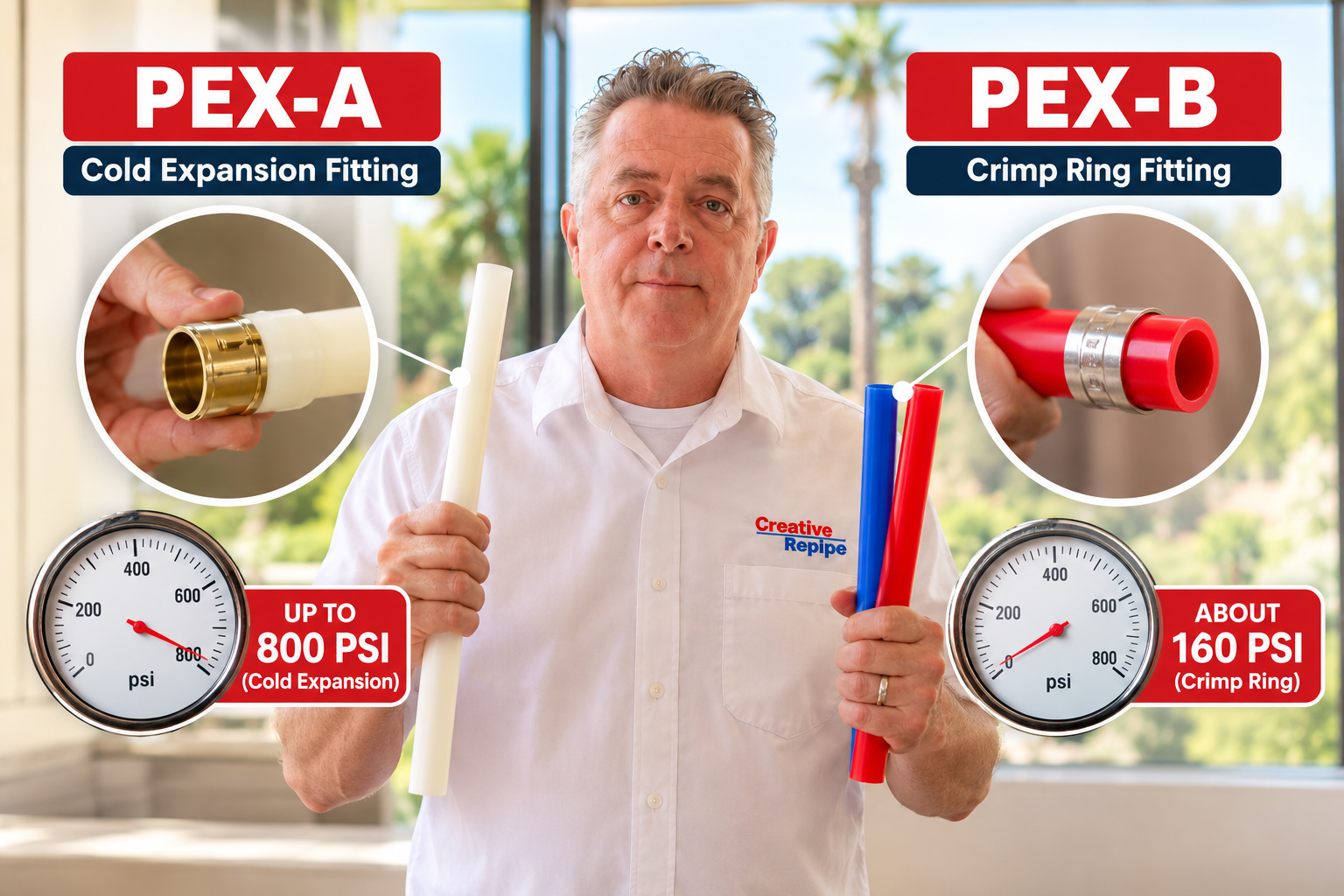
PEX-A and PEX-B are both cross-linked polyethylene pipe. The main difference is how the fittings connect. PEX-A uses a cold expansion fitting. PEX-B uses a crimp ring. In short, we use USA-made PEX-A, which we consider the highest quality PEX you can buy. The pipe and fittings are rated for 100 years.
Here is the difference side by side:
- PEX-A: Joined with a cold expansion fitting. A tool expands the pipe, then it shrinks back around the fitting. Our connection can hold up to 800 pounds of water pressure.
- PEX-B: Commonly joined with a crimp ring. A tool squeezes a metal ring around the pipe. Crimp connections hold about 160 pounds.
- The question: Is your quote PEX-A or PEX-B? Get the answer in writing.
How Do PEX-A and PEX-B Connections Work?
Put simply, the pipe type decides the fitting. According to a supplier guide from Boshart, crimp fittings go with PEX-B or PEX-C pipe. Cold-expansion fittings go with PEX-A pipe. So they are two different ways to make a joint.
First, with a crimp, a tool compresses a metal ring over the outside of the pipe. Second, with expansion, a tool stretches the pipe and a collar. Then the fitting goes in, and the pipe shrinks back around it. In the same guide, plastic crimp fittings have a smaller inside diameter, which can restrict flow. It says plastic expansion fittings come within 2% of the minimum inside diameter of metal fittings.
How Much Pressure Can Each Connection Hold?
In fact, this is the biggest difference between the two. Our cold expansion connection can hold up to 800 pounds of water pressure. In contrast, crimp connections hold about 160 pounds. That gap is one reason we install PEX-A.
However, pressure numbers can mean different things, so ask for the spec sheet. Also ask whether a number is a working rating or a hold test. Then compare the same kind of number on every quote.
Is PEX-A or PEX-B Better for an Orange County Home?
For PEX-A vs PEX-B for an Orange County repipe, we recommend PEX-A, and ours is USA-made. The whole system is rated for 100 years, including the cold expansion connectors. We consider it the highest quality PEX you can buy, so quality is where we start. Uponor, a PEX-A maker, says PEX-A is more flexible. It adds that a kinked PEX-A pipe can be repaired with a heat gun. In contrast, Uponor says PEX-B cannot be kink-repaired, so a coupling is needed. Because Uponor makes PEX-A, read that as one maker’s view.
To be fair, PEX-B is an accepted pipe, and many plumbers use it. California added PEX water distribution systems to its plumbing code in 2009, according to Pro Tool Reviews. Still, the point is not that one is dangerous. Instead, you should know what you are buying. As a result, a quote that says only “PEX” leaves out the part that matters.
What Should You Ask Before You Approve an Orange County Repipe Quote?
First, look for the word PEX on the quote. Then ask one more question: PEX-A or PEX-B? Also use this short list:
- Which type of PEX is in the quote? Ask for PEX-A or PEX-B in writing.
- How are the joints made? Expansion fittings go with PEX-A. Crimp fittings are common with PEX-B.
- Where is the pipe made, and how long is it rated? Ours is USA-made PEX-A, and the whole system is rated for 100 years.
- How much pressure can the connection hold? Ours holds up to 800 pounds; crimp connections hold about 160. Ask for the spec sheet.
- Who pulls the permit? The contractor should, and should schedule the inspections.
- What does the warranty cover? Ours is a Lifetime Transferable Warranty.
However, permits vary by city. For example, the City of Anaheim’s plumbing permit application lists Water Distribution (Repipe) as its own item. In addition, we pull the permits and schedule the inspections the city requires. Comparing PEX with copper instead? Then read our PEX vs copper guide for Orange County.
Take advantage of our 20% off special on a whole-house repipe. First, we come to your home and look at the whole system. Then we give you a clear answer and a firm price.
How Much Does an Orange County Repipe Cost?
Most whole-home repipes run $6,000 to $14,000 with us. However, that is an estimate, not a quote. Also, your price depends on home size, bathroom count, and plumbing access. As a result, we confirm a firm price in person after a free in-home estimate. For the full breakdown, see our whole-home repipe cost guide for Orange County.
How Does Creative Repipe Repipe Orange County Homes?
Creative Repipe is a whole-home repipe specialist serving Orange County and the rest of California. We back every repipe with a Lifetime Transferable Warranty. Most homes run $6,000–$14,000 for a full repipe, and most are done in a single day.
In addition, we install USA-made PEX-A, the highest quality PEX we can buy. The pipe and every fitting, including the cold expansion connectors, are rated for 100 years. You also never have to leave your home during the work. Wondering what it is like to stay put? Read what to expect if you stay in your house during a repipe in Orange County. Also, we hold a 4.9-star rating on Google from hundreds of reviews. Want to compare repipe companies? Then see the best repipe company in Orange County. Replacing old Quest pipe? Then read Quest pipe vs PEX in Orange County.
What Customers Say About Creative Repipe
4.9 stars from 276 Google reviews (October 2026). Read all reviews
"Throughout the process, it genuinely felt like they under-promised and over-delivered. Our old polybutylene plumbing was replaced with PEX-A, the work was completed properly, and they actually finished faster than the timeline we had originally been given."
"The install crew completed my install just about 3:30. Showed up early, ready to go at 8:30 am, and worked until completed. Tested everything and cleaned up after themselves."
Request Your Free Estimate
Still weighing PEX-A vs PEX-B for an Orange County repipe? We will look at your home. Take advantage of our 20% off special on a whole-house repipe. In addition, you get a clear answer and a firm price.
Get your free in-home estimate: https://creativerepipe.com/free-estimate/ Call (888) 373-0046 or visit CreativeRepipe.com.
Schedule Your Free Evaluation
We come to your home, look at everything, and give you a straight answer and firm price — usually within 48 hours of your request.
Prefer to call? (888) 373-0046
Frequently Asked Questions
What is the difference between PEX-A and PEX-B?
Both are cross-linked polyethylene pipe, and they look almost identical. The main difference is the connection. PEX-A uses a cold expansion fitting, and PEX-B commonly uses a crimp ring.
Which PEX does Creative Repipe use?
We use USA-made PEX-A, which we consider the highest quality PEX you can buy. The whole system is rated for 100 years, including the cold expansion connectors. So we confirm the pipe and fittings in writing at your free estimate.
Is PEX-B a bad pipe?
No. PEX-B is an accepted pipe, and many plumbers use it. However, you should know which type is in your quote. A quote that says only “PEX” leaves out the part that matters. We use PEX-A and only the best quality products.
How much pressure can a PEX-A expansion connection hold?
Our cold expansion connection can hold up to 800 pounds of water pressure. Crimp connections hold about 160 pounds. Ask for the spec sheet, and ask whether a number is a working rating or a hold test.
Is PEX approved for plumbing in California?
Yes. PEX water distribution systems were added to the California Plumbing Code, with regulations effective Aug. 1, 2009. Your city’s building department can confirm local rules.
How much does a repipe cost in Orange County?
Most whole-home repipes run $6,000 to $14,000 with us. The price depends on home size, bathroom count, and plumbing access. We confirm a firm price after a free in-home estimate.
0 Comments